

Finding papers isn't the hard part. Knowing which ones answer your question, and being able to show exactly where each claim came from, is.
That's what we spend Consensus 101 on. In our first session of the school year for students, we didn't tour features. We picked one question, Does magnesium improve sleep quality?, and followed it the way you would for a real assignment: from a first search, to papers we'd checked ourselves, to a library we could share and keep building. Here's how that went, so you can follow along with your own searches.
Start With the Question You'd Actually Ask
There's no special syntax to learn. I typed the question exactly as I'd say it out loud. Consensus searched its 220M+ papers using keyword and semantic search together, which is why it finds relevant work even when the authors phrased things differently than you would.
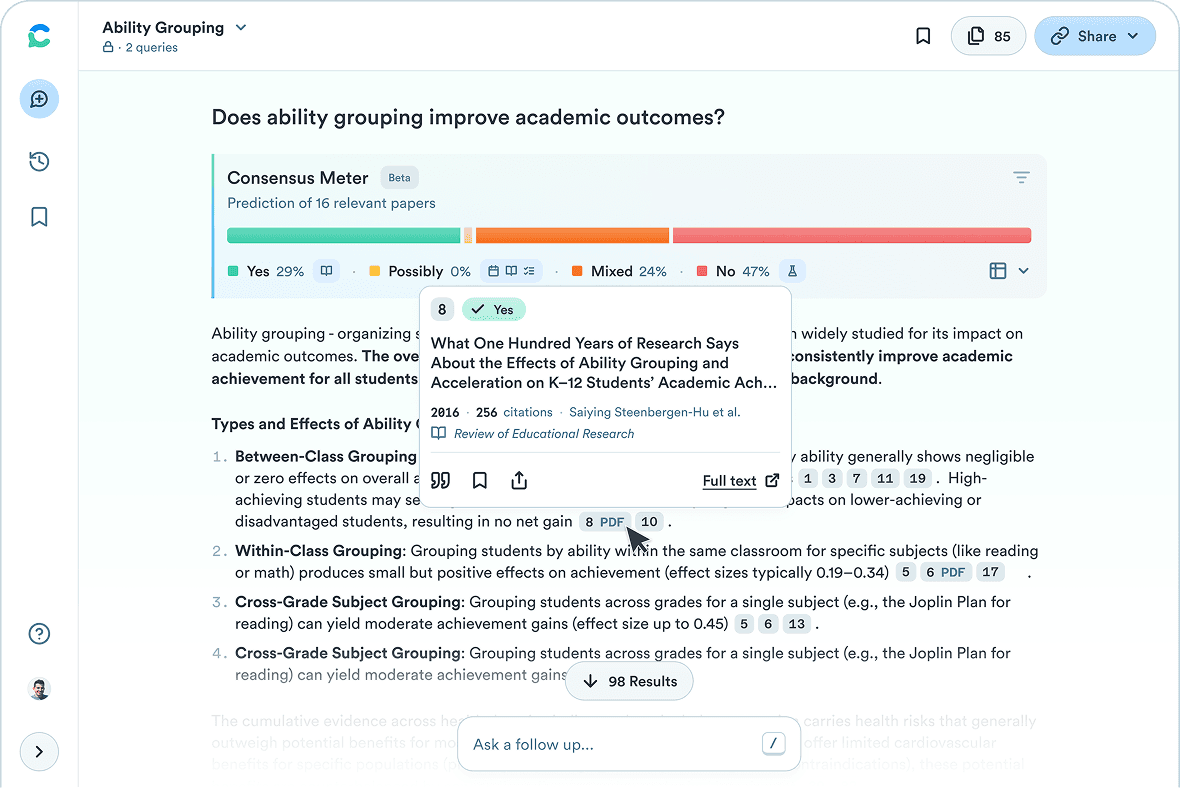
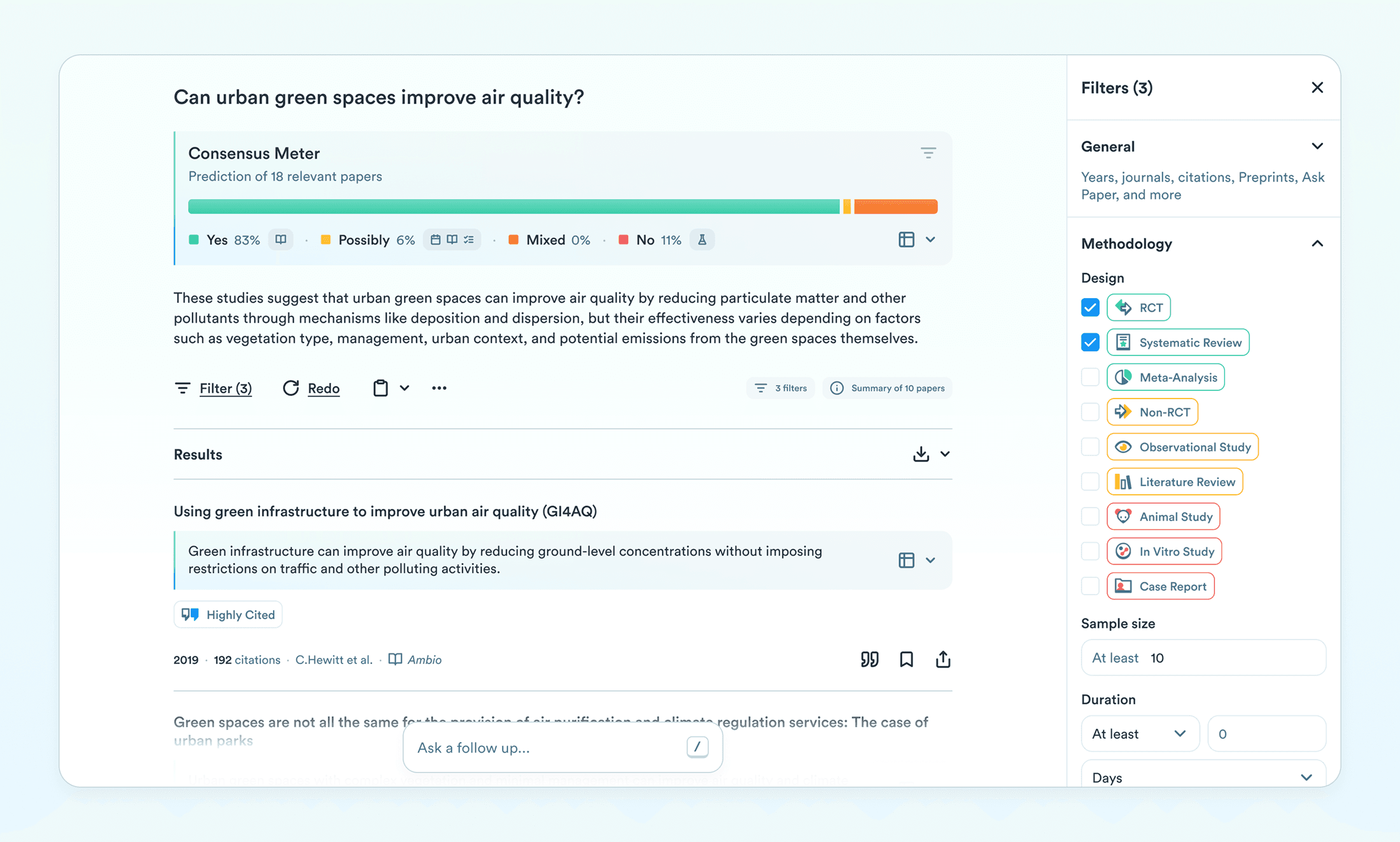
Because it was a yes/no question, the first thing on screen was the Consensus Meter. It gives you a quick read on where the findings of the retrieved papers land, and each result is color-coded to match. And when a question needs more than a quick read, Deep runs a longer, literature-review-style analysis. On the magnesium question it ran 31 steps and came back with a claims-and-evidence table, a timeline of the research, and the gaps it found.
The Meter makes a useful first impression. It's also where a lot of people stop, and that's where people make their first mistake.

The Step I Never Skip
Look closer at the results and the story gets more interesting. A 2022 systematic review near the top found that observational studies link magnesium to better sleep, but the randomized trials were mixed. A summary can't make that call for you. You have to see the papers.
So that's what we did next. Hover over any citation in the analysis and you'll see the exact sentence it came from. Click Open, and the PDF slides in beside your results, scrolled to that passage and highlighted. (A checkmark on a citation means Consensus read the full text; no checkmark means it worked from the abstract and metadata.) That's the moment the answer stops being a summary you have to trust and becomes a set of claims you can check.

From there, I switched the results to Table View, which lines papers up by population, methods, sample size, and duration. It's the fastest way I know to decide which three papers deserve a full read, and it pays off well beyond this example. Ask whether social media hurts college students' sleep, and Table View shows right away that most of the top results are cross-sectional surveys. That's the difference between writing "is associated with" and "causes" in your paper, caught before you've read a single abstract.
Try it → Does social media use affect sleep quality in college students?
Where a Search Turns Into a Project
Once a few papers held up, I saved them to a new collection in My Library called "Magnesium and sleep quality." If you already keep references in Zotero, EndNote, or Mendeley, you can import them, or export your results as RIS, CSV, or a bibliography, so nothing gets stranded. And if you're working with a study group or lab partner, the Share button sends the whole collection by link or email.
What students usually don't expect is that a collection isn't just storage. You can ask it questions. I asked mine, "What important papers am I missing, and what are the research gaps?" Consensus read what I'd saved, ran new searches, and came back with papers that weren't in the collection yet, plus the gaps it saw.
That's especially handy at the start of a literature review, when the first page of results tends to be recent and narrow. Search retrieval practice and exam performance, for example, and the top results are new classroom studies, one comparing two course sections of 19 students each. They're a fine place to start, but they build on older, heavily cited work your review can't skip. Save the good ones, ask the collection what's missing, then build a Citation Graph from your strongest papers. It maps what they cite and what cites them by year, with bigger circles for more-cited papers. On the magnesium graph, that's how we found a paper with more than 33,000 citations.
Try it → Does retrieval practice improve exam performance in university students?

Use It for the Part of Research It's Built For
Near the end of the session, someone asked how searching in Consensus compares with asking ChatGPT. Consensus only searches across academic literature, providing better results you can trust. But, you can also connect Consensus to ChatGPT, Claude, or Copilot so those chats pull from real papers, too. The reading and the thinking are still yours.
Try It on Your Own Question
Before your first search, set your university in Settings so paper links go straight to the full text your library already pays for. Then ask the question you're actually stuck on, check the passages behind the answer, and save what holds up. Once the collection starts to take shape, ask it what you're missing.
Try it → Does magnesium improve sleep quality?
If you'd rather do it with us, bring your question to the next Consensus 101. It's 30 minutes every week, and it's free to register.